

Repurposing: Structures from One Era to the Next
By Sarah Mowrer
Studying Central Europe in this program often involves being in the same space while recognizing that it has undergone several fundamental changes throughout history. Space is a geographical location that exists in our minds through observation and memory of physical remnants. I was able to observe the development of these spaces across multiple eras since they have changed through ownership and the purpose it is used for by a given community. It is natural that certain structures lose their purpose as their functions become redundant over time. However, I found it interesting how rather than being destroyed or left to decay, physical structures can persevere across different periods through repurposing efforts. Repurposing buildings of the past brings them into the present by giving them new relevance. The process of reclaiming old buildings for new uses often involves transferences to a different sphere of purpose. Such spheres include, but are not limited to, cultural, historical, industrial, tourism, and art purposes.

In KulturBrauerei Courtyard
For some buildings, repurposing is like a revitalization. A space that would feel dead has new life breathed into it when a repurposing shifts it into a place with an active community. In Berlin, Germany, we made a stop at an example of this revitalization phenomenon at the KulturBrauerei (“Culture Brewery”). The KulturBrauerei is an architecturally beautiful complex of buildings with a large center courtyard area that takes inspiration from the image of a fortified medieval castle. Currently, it is a venue for cultural community activities such as concerts, festivals, food markets, and theater shows. The complex houses a multiplex cinema, theaters where performances are given by people with disabilities, a theater for Russian plays meant to open a dialogue between the east and the west, and a House of Poetry which offers a stage for emerging poets. At the time of my writing, it will be host to the Scandinavian Lucia Christmas Market, and when I was there, people were still cleaning up from a previous event.
However, Kulturbrauerei was not originally a “brewing” space for culture development, but rather a literal brewing industrial complex for beer. By 1921, it was the largest lager brewery in the world. The complex’s darkest times were during the period it was nationalized by the Nazi regime and prisoners of war underwent forced labor in its cellars. The brewery continued its usage in communist state postwar era East Berlin until its closure in 1967 due to equipment degradation. After the brewery was no longer viable as an industrial complex, it was spared demolishment when it was reimagined as a site where culture could flourish. KulturBrauerei is an example of a building kept after its time and imbued with a new purpose in order for the preservation of significant architectural style that lends to the beauty of the cityscape.
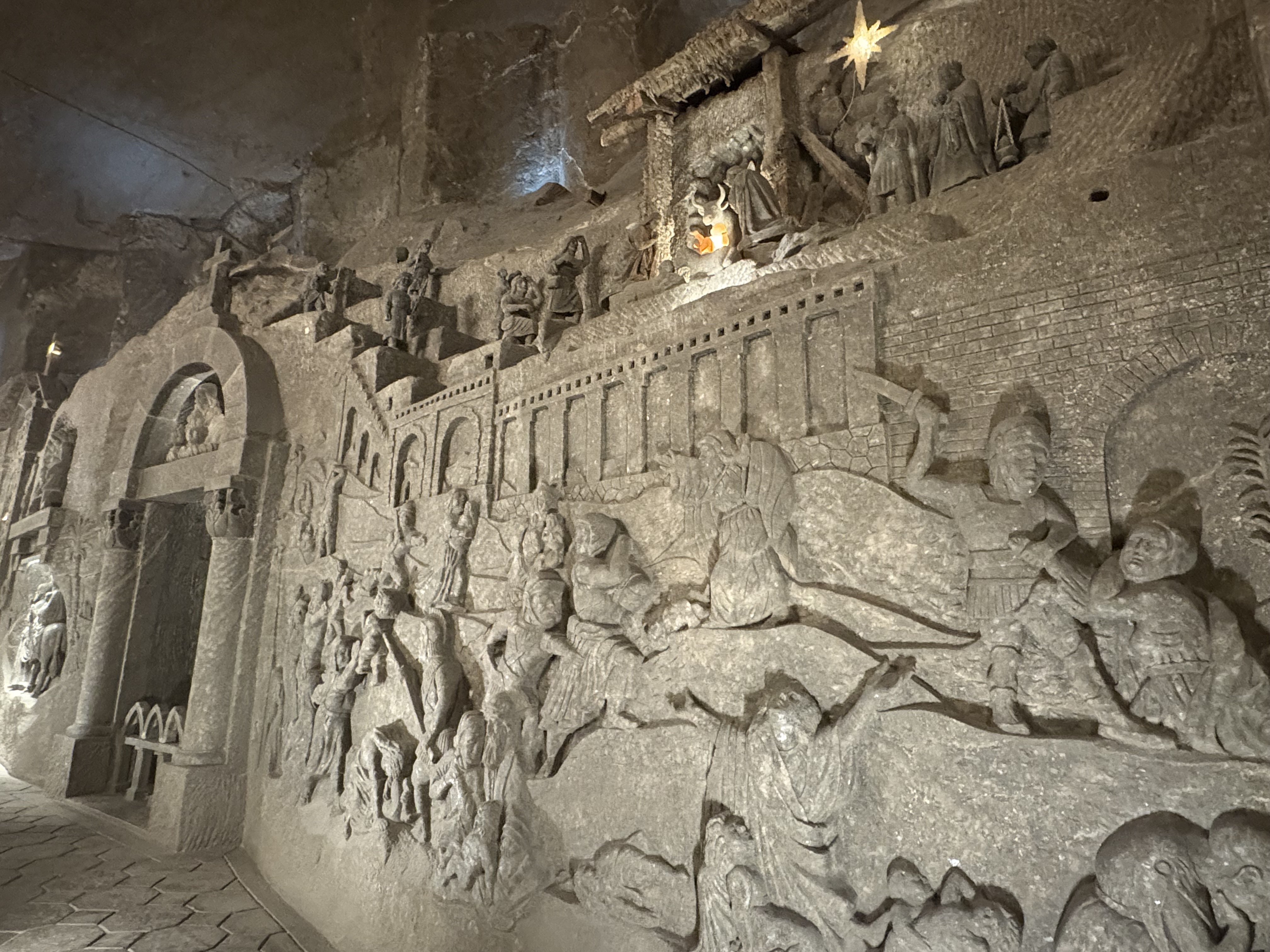
Reliefs made by miners.
Path of Jesus Christ
In a similar vein to the KulturBrauerei, other spaces can make a transfer away from an industrial purpose that has since been fulfilled. The Wieliczka Salt Mines in Poland, near Krakow, had great historical relevance in the development of Poland as a medieval empire because it brought in substantial wealth and was an employer of its people at a time when salt was a strategic commodity in the world. It has been mined over a time span of centuries, only halting in 1996. By no means, however, are the mines irrelevant now. Recognized as a UNESCO World Heritage Site, the inside includes multiple statues and reliefs carved completely from rock salt. The reliefs are incredibly intricate and span large swathes of a wall in an extravagant ballroom complete with multiple large chandeliers (also made of salt). One relief, for instance, is a replica of The Last Supper. Walking through the labyrinthine passages brings you to impressive chambers with high ceilings, towering statues of famous figures such as Nicolaus Copernicus, chapels (still used for weddings and mass services), and stunning underwater lakes accompanied by musical sound effects. The Wieliczka Salt Mines bring in over a million tourists every year. While waiting to enter the mines, I noticed designated areas for visitors from different countries. Tours and audio guides were available in multiple languages, underscoring the international draw of the site. Throughout my tour, the interesting history of the mines, its visitors, and its technology were relayed by the tour guide and through the study of the carvings in the large chambers where salt had been extracted.
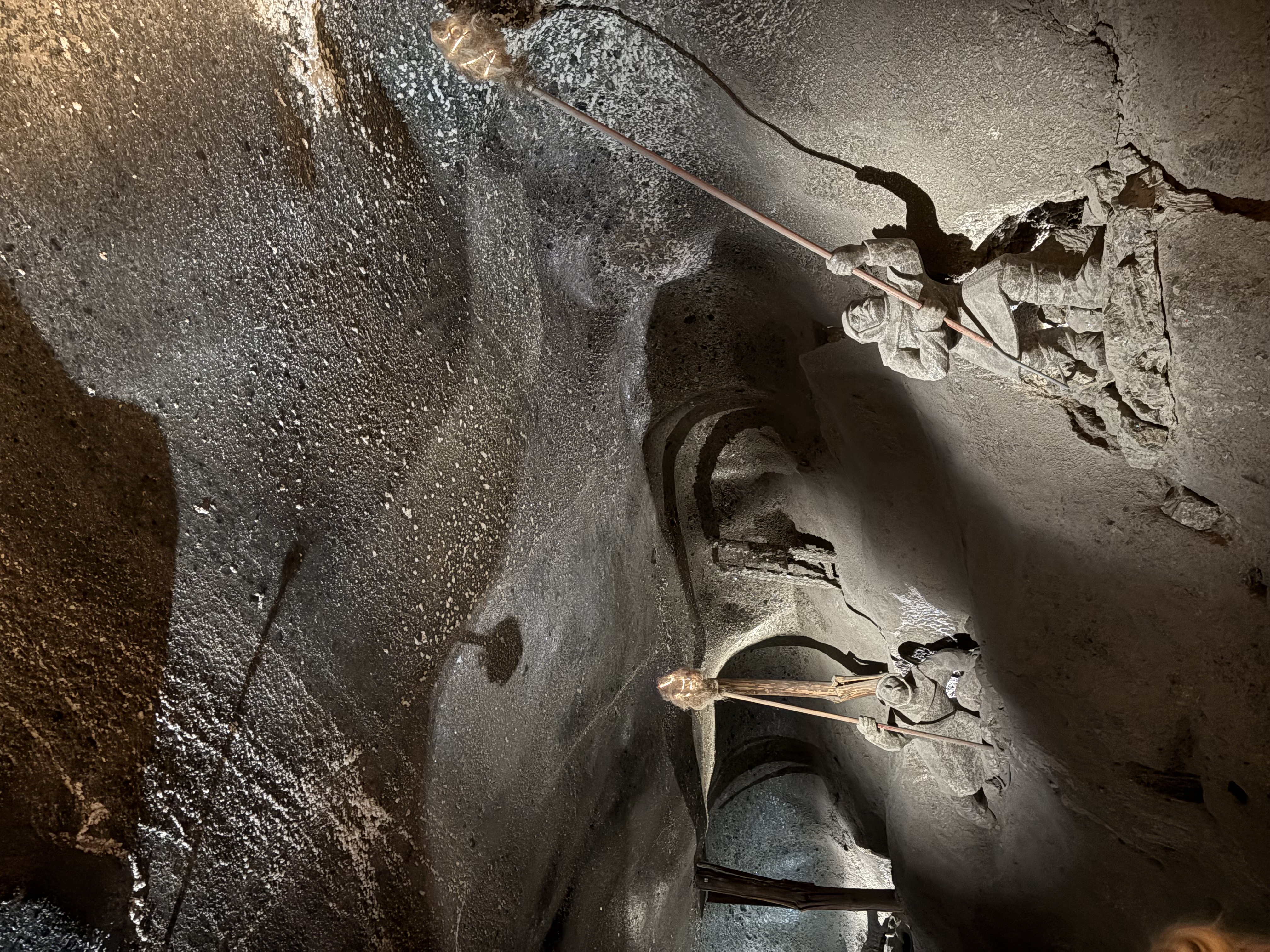
Wore wet clothes, caused explsipm, then hurt miners followed
Therefore, the salt mines of Poland continue to be important in modern times not for producing salt commercially, but for its repurposing through its place in the tourism industry because of its historical significance and rock salt art. The repurposing of the salt mines is also distinguishable since it maintains a characteristic of remembrance. Instead of repurposing as erasing the memories of a space, the memory behind the Wieliczka Salt Mines is preserved since its modern tourism function is driven by its art created by miners and its historical role in Poland.
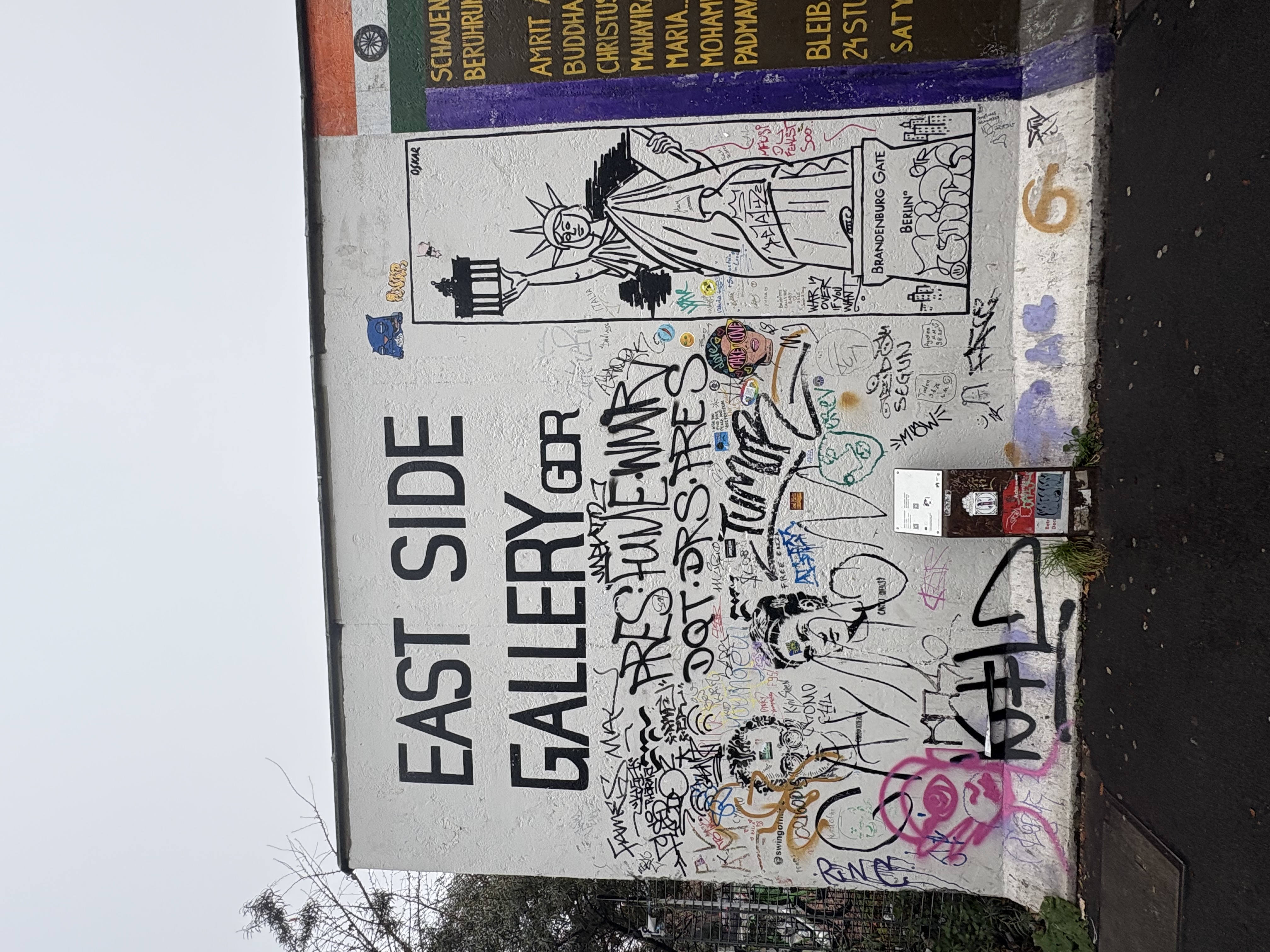
Beginning of East Side Gallery
Another site that has been repurposed is deeply tied to major historical events of the 20th century. The East Side Art Gallery in Berlin, Germany is the longest open-air art gallery in the world. It exhibits a series of wall murals painted by 118 artists from 21 countries on the east side of the largest still-intact stretch of what was once the Berlin Wall. Artists began painting on the east side of the Berlin Wall, formerly part of East Germany, following its and the communist regime in Germany’s fall on November 9th, 1989; the date that led to a new era of freedom and a reunification with West Germany for East Germans. Each section of the wall contains a unique mural that represents the artists’ hopes and feelings on a change to a new, freer political future that began with the fall of the Berlin Wall and the end of the Cold War. For instance, the mural by Birgit Kinder, “Test the Rest”, depicts a Trabant car—a model produced in East Germany—with a license plate with the date November 9th, 1989, driving through the Wall, thereby breaking the barrier to freedom in the West. The repurposing of the Berlin Wall, once a tool of oppression and division under the East German state, to an art gallery looking to a better future represents the reclamation of both the Wall itself and a new, reunified Berlin. In this way, Berliners reject what the Berlin Wall represented under the communist regime and propose a future of greater freedom of expression and collaboration.

Test the Rest by Birgit Kinder
Spaces are shaped and, at times, haunted by the past through the continuing presence of what the buildings of a previous era represent. However, repurposing old structures for the new needs of the community is a viable path to take for creating an improved future. It is the nature of buildings to be capable of having fluid purposes. Furthermore, repurposing allows for evolution without total separation from the memories of the past through the continuity of a structure occupying a space. I believe the function of repurposing is important to a region such as Central Europe, where the past informs current life and identity.

