

Rebuilding Berlin’s Palace: Erasure of Identity or Another Step Towards Berlin’s Reunification?
By Jack Yoon
In the words of Karl Scheffler, a German art critic in 1910, “Berlin is a city condemned always to become, never to be.”1 Through his words, Berlin is a city built through constant change, whose identity is never fully being something, but rather always becoming, continuously moving forwards and backwards across time. More than a century later, these words could not be more true, as Berlin, the capital of a now reunified Germany, continues to display a physical urban landscape that reflects its turbulent history under different regimes throughout the 20th century. Although Berlin is now the capital of a reunified, democratic Germany, I was surprised to see, after so much destruction during World War II and the Cold War, how many past relics from Berlin’s past identities remain. When standing on Unter Den Linden, it was striking to see how, in a visible straight line, numerous structures reflecting the process of Berlin constantly remaking itself throughout the Kaiserreich, Nazi Germany, and East Germany. Situated not far from each other, I was able to see the TV Tower on Alexanderplatz, the Russian (previously Soviet) Embassy, the Reichstag, the Brandenburg Gate, and the Berlin Cathedral. Together, the contrast in each building’s facade, a representation of different historical periods and ideologies, reflects Berlin’s many past identities. Although Berlin has changed dramatically since 1910, the contrast today on Unter Den Linden reflects the city never fully being something, but always becoming a product of an era, constantly evolving with time. However, I was most puzzled by the newly rebuilt Berlin Palace, a Prussian palace standing on the previous grounds of the Palace of the Republic from East German communism. If Berlin is a city to always become something else, then why would the new reunified German government destroy a symbol of East German heritage to rebuild a forgotten royal palace that was destroyed more than half a century ago? Was rebuilding Berlin’s Royal Palace a move to erase identity, or was it another step towards Berlin becoming reunified? Exploring the Berlin Palace made me wonder not only what its reconstruction meant in terms of Berlin’s identity, but also how it affected the city’s memory today.

The Berlin Palace Today. Photo by Jack Yoon
When exploring the inside of the Berlin Palace, there was something off-putting about the building’s atmosphere. Although on the outside, the palace was a near copy of the 17th-century Royal Palace on three of its sides, inside was not the home of the old autocracy, but the Humboldt Forum museum, a center for culture, history, and science. Walking through the main entrance under the Eosander Portal to enter the modern palace, it was clear through the detail in the building’s facade that on the outside, the Berlin Palace honors the old forgotten memory of Prussia and the Kaiserreich. Seeing this, there were also immediate connotations of the palace to Germany’s colonial and imperial history. This caught me off guard when entering inside, as ironically, the site now hosts various museums and exhibitions such as the Berlin Exhibition, the Ethnological Museum, and the Museum of Asian Art. Although the palace was very clean and modern, there was a sense of it being almost too perfect. To me, there was a strange feeling of the building almost being haunted by the previous Palace of the Republic. By rebuilding the Berlin Palace, it seemed like a forceful step in erasing East German identity while reminding Berlin of the memory of the Kaiserreich instead. However, those in charge of the several museums now housed in the rebuilt palace would argue that the reconstruction of the Berlin Palace was instead a move to put forward Berlin’s global position to help expand Berlin’s identity in relation to the rest of the world through its modern and colonial era exhibitions.
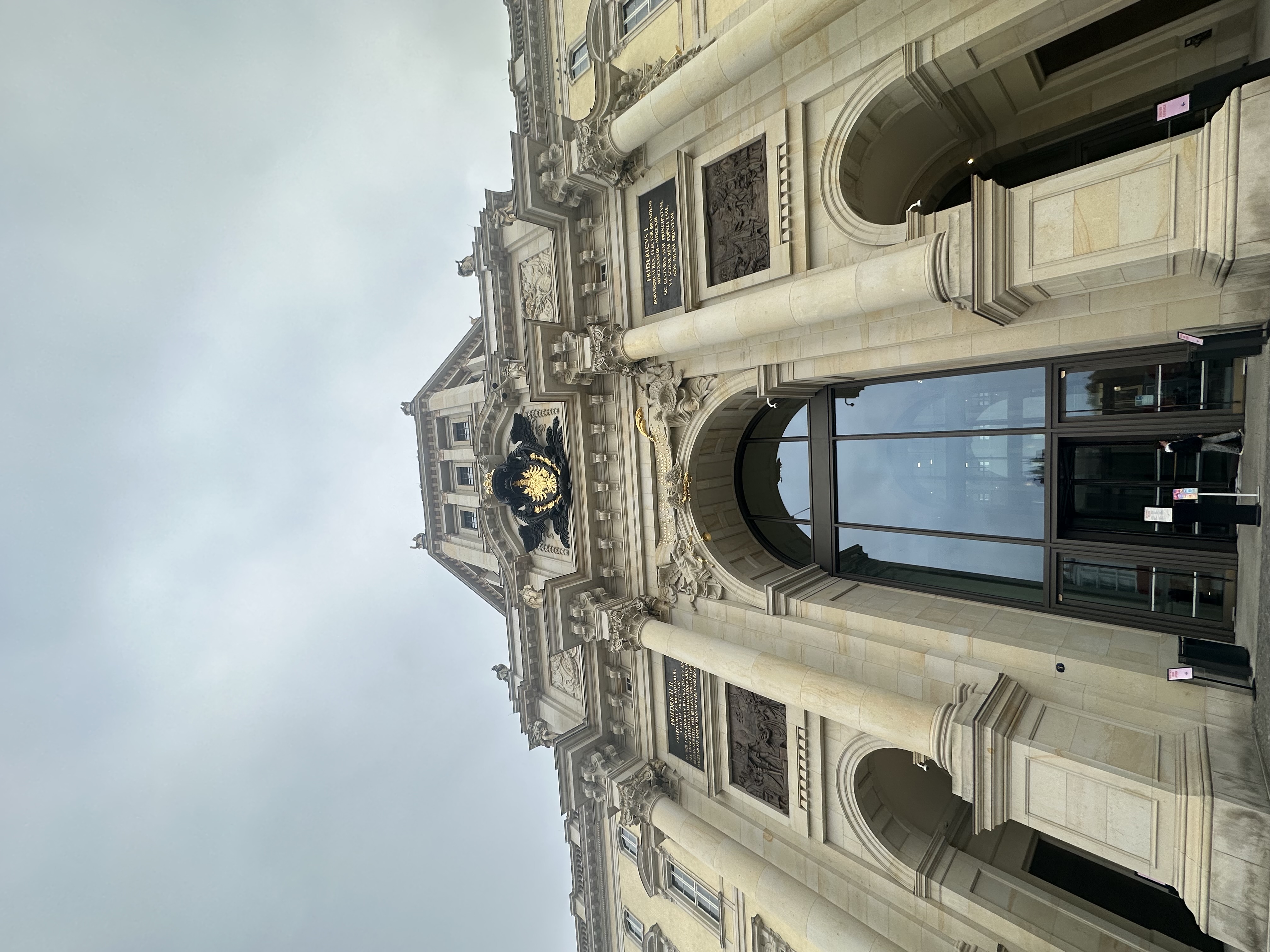
Entering through the Eosander Portal. Photo by Jack Yoon
The site of the Berlin Palace today has had a long and important history in Berlin’s identity. When the original Royal Palace was built in the 15th century, it housed the royalty of Brandenburg, Prussia, and then Germany from 1443 to 1918, tying Berlin’s identity to the Hohenzollern monarchy. It would only be after World War II, when the original palace was damaged due to Allied bombings, did the newly established East Germany decide to destroy it in 1950. By doing so, the communist government was effectively erasing the old monarchical identities and memories from their half of Berlin in order to become something else. In its place, the Palace of the Republic would be opened in 1976 as a modernist socialist palace that served the people.2 Replacing what once was a palace for only the elite, the Palace of the Republic was not only where the East German government met, but also a “palace of pleasure” for the average citizen, with its glass façade symbolizing the government’s claimed transparency.3 Even though the palace would get the nickname, “Erich [Honecker]’s Lamp Shop,” by residents, it became a popular recreational space in East Berlin where residents were able to relax and buy consumer goods.4 Since the palace became one of the most attractive and modern sites in East Berlin where residents could spend their personal and recreational time, the Palace of the Republic naturally became an important symbol of East German identity while holding thousands of fond personal memories. Just like East Germany itself, the idea of the Palace of the Republic disappearing seemed impossible for many at the time.
Although I was aware prior to my visit of the existence and destruction of the Palace of the Republic in rebuilding the Royal Palace, I was surprised to hear from one of my Berlin-based professors about how personal people from the former East Germany, including her and her family, saw its destruction when having a class discussion inside the rebuilt palace. What stood out to me was hearing that even though the Palace of the Republic was primarily where the East German parliament met, to her, it was also a site of personal heritage and storytelling. Although I understood the old Palace of the Republic could be considered a bland concrete box with asbestos, hearing the nostalgia the professor had through her childhood memories showed me how affected East Germans were by the reconstruction of the Royal Palace. Whereas previous East Germans had little to no relation to the site today, back then, the socialist palace was where people ate on dates or hung out with friends. Even though thousands of Berliners had fond nostalgic memories inside the Palace of the Republic, it was destroyed to rebuild the Royal Palace, erasing part of their identity as East Germans and leaving only an aging memory of what once was.
Hearing these stories about nostalgia towards the past reminded me of my hometown, New York City, and the Twin Towers, which were attacked and destroyed on September 11, 2001. Although I was born in 2004, I always understood the 90s and the year 2000 as the best years of New York City from my parents and old photos/movies. Growing up in Brooklyn, I always saw Lower Manhattan as a child, always aware of the obvious gap in my hometown that I never got to see. There was a certain golden charm about the memories of New York before 9/11 that I never got to experience, but my parents did. However, as I got older and saw my hometown change, I’ve also grown nostalgic towards my memories of New York’s identity a few decades ago compared to today.
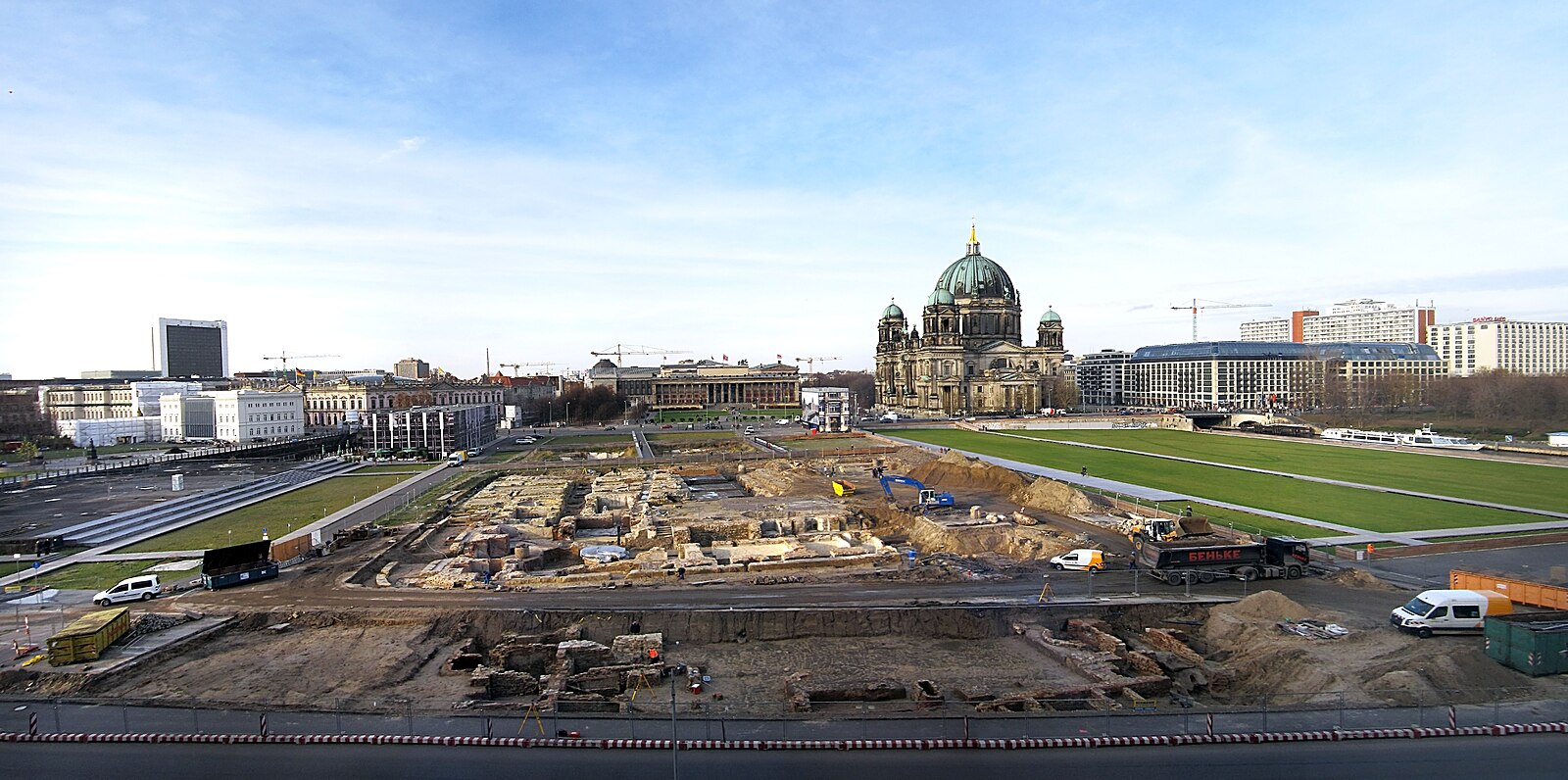
Empty site after destruction of the Palace of the Republic in 2009. Photo Credit: Gryffindor. Source: Wikimedia Commons
When the Berlin Wall fell in 1989 and East Germany reunified with West Germany in 1990, the identities of East Germans were immediately put into question as the West, holding a significantly greater amount of social, political, and economic power, essentially absorbed the East. With this, the new reunified German government would immediately shut down the Palace of the Republic due to having asbestos. Although the asbestos would be cleaned, some previously West German politicians called for its demolition in the name of reunification, citing its heavy political association with East German totalitarianism as a required step in order to heal a reunified Berlin. Eventually, to the disappointment of former East Berliners after years of debate, the German Federal Government would vote in 2003 to demolish the palace and reconstruct the previous Royal Palace. Although the legacy of East German communism was at best mixed, many of the nostalgic memories people had of the Palace of the Republic only represented the best of East Berlin identity. To East Berliners, the palace became synonymous not only with East Germany, but where they came from. By destroying the Palace of the Republic, not only was one of the most iconic symbols of East Germany destroyed, but also the personal sense of identity tied to it. Its destruction should have meant no longer identifying either as an East or West Berliner, however to many in the former East Germany, it instead came to represent an ever growing political and economic divide in a reunified Germany.
The reconstruction of Berlin’s Royal Palace reflects Berlin’s long struggle in finding its identity and becoming something else. Although Germany was reunited, the legacy of East Germany had to be erased, and what best represented this was the Palace of the Republic, the political heart of East German communism. In the name of reunification, its destruction meant erasing a stain on a now bygone era, defining West Germany’s victory in the Cold War. Unlike other iconic structures from East Berlin, such as the Brandenburg Gate or the TV Tower on Alexanderplatz, the Palace of the Republic could not be rebranded for Germany’s new reunified era due to its deep ideological and political connotations. Although a needed step in Berlin’s reunification, it also destroyed thousands of identities of East Berliners who were once connected to it. No longer could the future children of Berlin see the site as a time of division, as something new, the Berlin Palace, was built in its place for the next generation to connect to instead. By reconstructing Berlin’s Royal Palace, not only is the site essentially returning to its pre-war self, but like the Palace of the Republic, it is again following a trend of state sponsored identity where the government plays a decisive role in what Berlin should become. No longer is Berlin meant to be a divided city from the Cold War, but is now becoming a reunified democratic city where, through a democratic vote, a symbol of East German totalitarianism was destroyed in order to rebuild Berlin’s Royal Palace, now a space where German history is critically examined with openness and reflection. The removal of the Palace of the Republic for Berlin’s Palace on Unter Den Linden showed me the street wasn’t just a mess of bygone eras, but represents Berlin’s ability to take in some of the old and incorporate it to become something else. Although it was strange seeing a newly rebuilt royal palace, like other historic structures, the Berlin Palace became something else, following Berlin’s identity in becoming a reunified city. Importantly, the reconstruction of Berlin’s Royal Palace shows how countries like Germany can negotiate identities to forge a new democratic path as East Berlin and the Palace of the Republic become a fading memory.
Notes:
- BootsnAll. n.d. “Berlin: 7 Things You Should Know About the Ever-Changing City.” Accessed December 2, 2025, https://www.bootsnall.com/articles/7-things-about-berlin.html.
- Berlin. January 15, 2025. “Berlin Palace.” Accessed December 2, 2025, https://www.berlin.de/en/attractions-and-sights/3561341-3104052-berlin-palace.en.html.
- Smarthistory. October 21, 2018. “Negotiating the past in Berlin: the Palast der Republik.” Accessed December 2, 2025, https://smarthistory.org/palast-der-republik/.
- Smarthistory. October 21, 2018. “Negotiating the past in Berlin: the Palast der Republik.” Accessed December 2, 2025, https://smarthistory.org/palast-der-republik/.

